

3D-Printed Heat Exchangers, Engineered at Dolphin Group
Additive manufacturing lets Dolphin Group build heat exchangers with internal geometries that conventional manufacturing cannot produce.
See the Tech Inside Our
3D-Printed Heat Exchangers
Optimized Lattice Structure
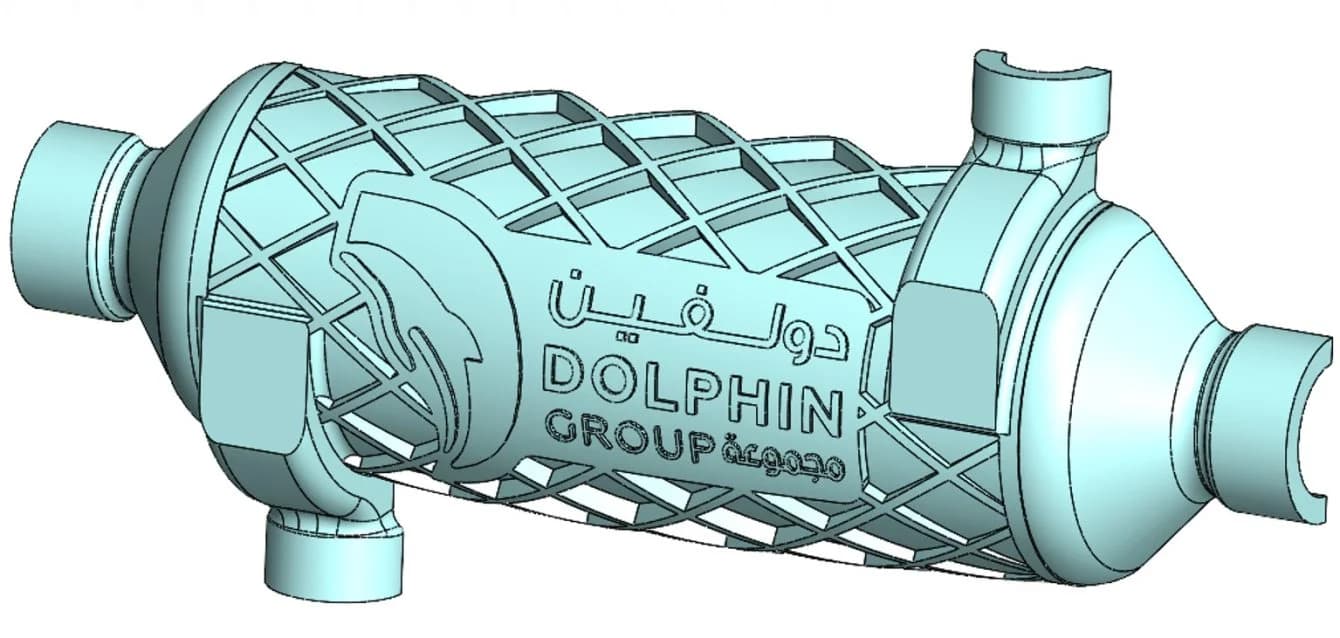
Dolphin Group prints the exchanger body as a lattice of crossing struts rather than a solid wall. Engineers set the cell size and strut thickness for each duty, enhancing heat transfer while reducing weight and material consumption.
For representation purposes only
Heat Exchangers,
Reimagined in 3D
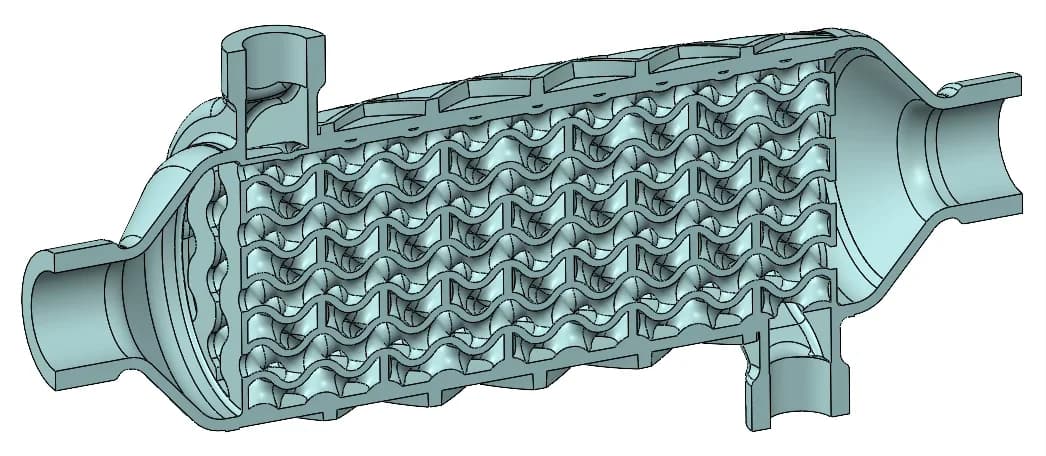
Dolphin Group uses additive manufacturing to build heat exchangers that combine high efficiency with full customization. The process produces intricate geometries unavailable through conventional manufacturing, supporting tailored solutions for specific performance requirements.
Engineers pair advanced CAD software with 3D printing to create heat exchangers with optimized interior structures. These structures are designed to enhance thermal transfer efficiency while reducing material consumption, giving durable, precise and sustainable equipment for challenging industrial environments.
Intricate geometries
Internal forms conventional manufacturing cannot produce.
Optimised interiors
Structures tuned to raise thermal transfer efficiency.
Less material
Lower material consumption without compromising durability.
From Duty Specification
to Printed Unit
Define the duty
Engineers capture fluids, temperatures, pressures, footprint and connection requirements.
Design in CAD
The interior structure is modelled and optimised for thermal performance and material use.
Print the unit
Additive manufacturing builds core, manifolds and supports layer by layer as one body.
Verify and deliver
The finished unit is inspected against the design before it ships to site.
Discuss a 3D-Printed Heat Exchanger
Share your duty requirements and our engineers will assess whether an additively manufactured design is the right fit.